Tickets
Alongside the SKNK DEX, players can open a ticket against the protocol and attempt to draw funds directly from a SKNK pool. Any token participating in an SKNK pool can be used against a ticket, with maximum returns based only upon the depth of the targeted pool.
Players can play directly against the protocol or via applications/games built upon SKNK.
A maximum of 1% of a token reserve can be won in a single ticket.
Creating a ticket on SKNK is permissionless - anyone can play or build on top of SKNK.
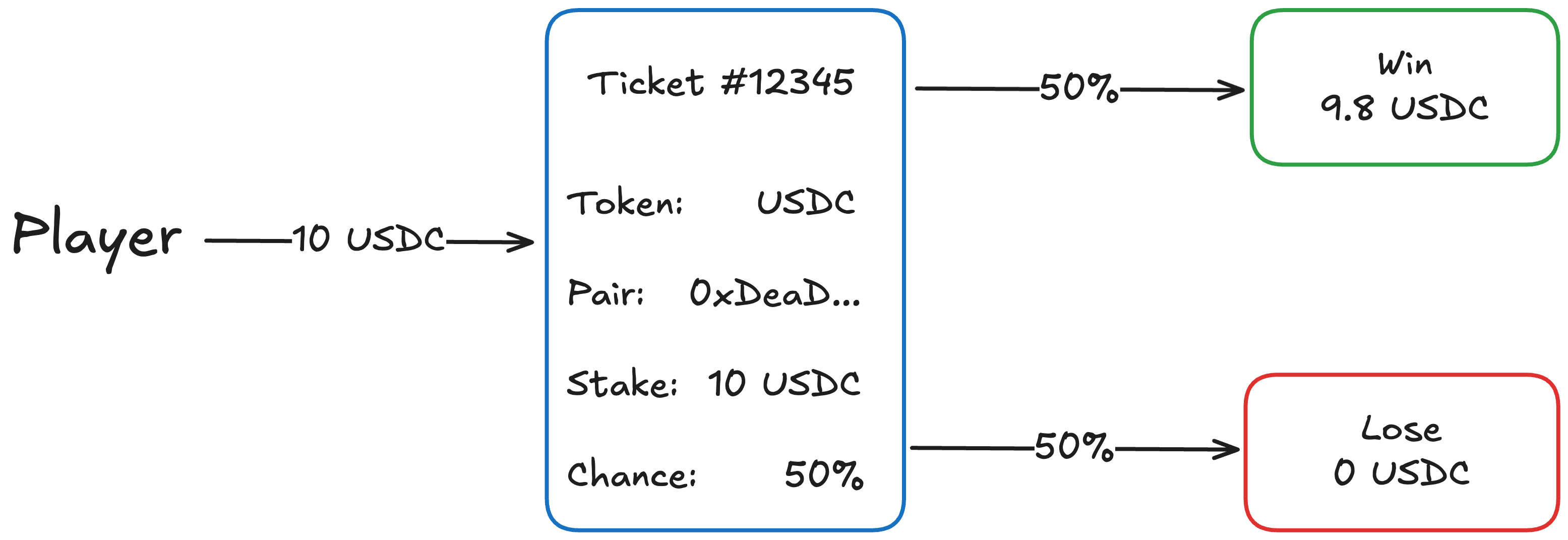
Provide a compatible game token (or ETH), select a pool, choose a player stake and win chance, and submit a ticket to the protocol. The player stake is taken at the time of ticket creation and is returned on a winning ticket, alongside winnings drawn from the target pool.
Ticket Settlement
The SKNK protocol integrates Chainlink VRF to provide safe, provably fair randomness for determining a ticket's outcome with high reliability and near-instant resolution. Ticket settlements are atomic, so players are credited with winnings as soon as the VRF response is returned successfully.
The SKNK protocol will hold the balance of player winnings upon a winning ticket. These can be used in further games or withdrawn to fully exit the protocol.
Games built on top of the protocol will be the custodians of player funds. Players must rely on games correctly implementing withdrawal flows.
Ticket Cancellation
If the VRF service fails to respond, a ticket cancellation request may be triggered once the appropriate cancelPeriod has elapsed. This returns the stake to the player and voids the pending ticket.
Ticket Lifecycle
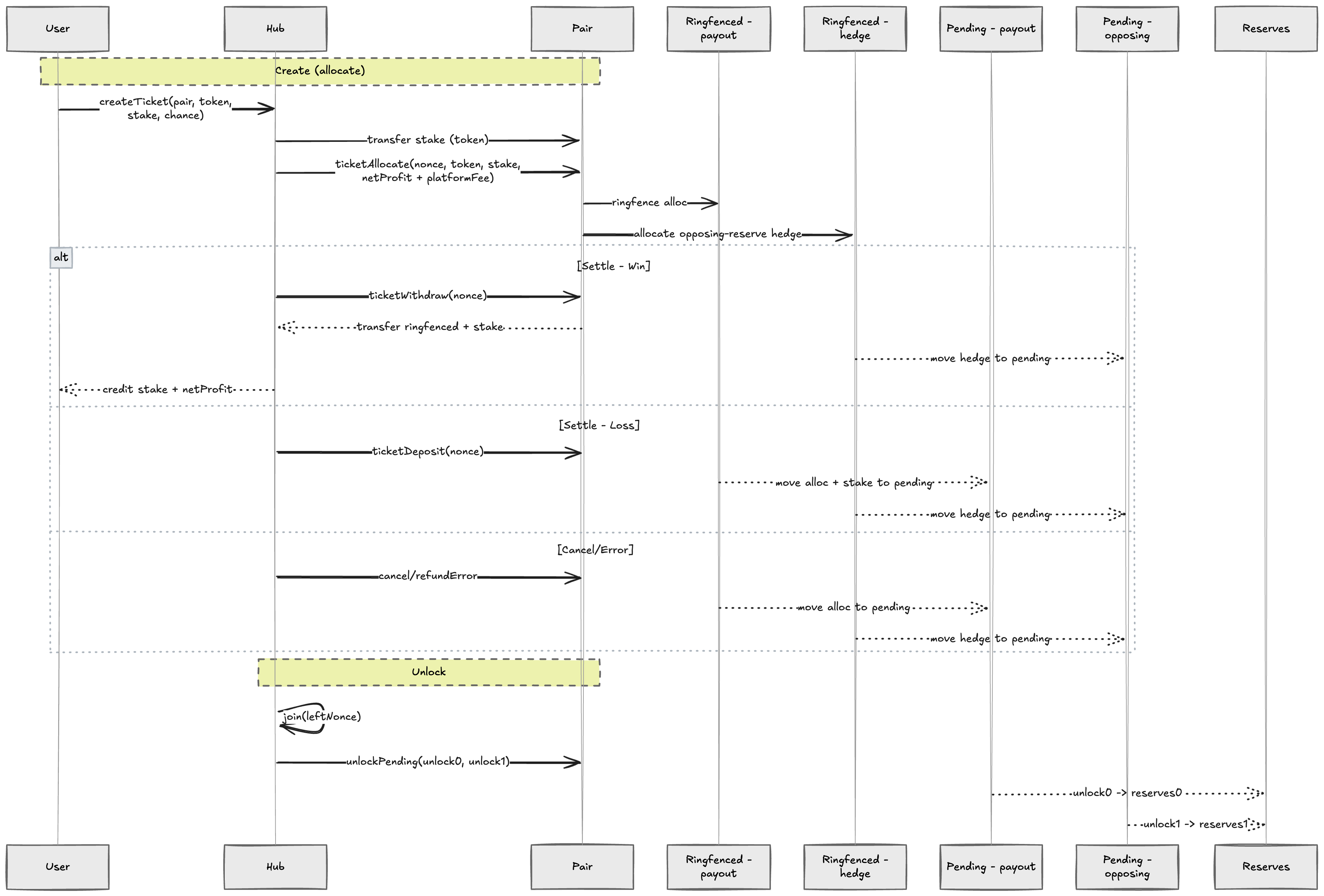
The chart below outlines the complete lifecycle of a game ticket. It can be broken down into three distinct phases: pending, settled, and confirmed.
Pending State
The initial state of a ticket. When in the pending state, the stake has been captured from the player and moved to the target pair contract, where it is tracked in the stake pot. The potential winnings and hedge from this ticket are moved to the ringfenced pot.
The ticket is now awaiting settlement by the VRF response.
Settled State
Once the VRF callback is completed, the allocated funds will be in one of three states:
Ticket win
When the player wins the ticket, both stake and ringfenced funds are transferred to the SLPHub, with winnings credited to the user and the fee credited to the protocol. The hedge is moved to the pending pot.
Ticket loss
When a ticket is marked as a loss, the player stake is retained by LPs. The stake and ringfenced funds, including unused winnings and hedge, are moved to the pending pot.
Ticket cancel/error
For cases where a ticket cannot be settled (improper token, VRF fails to respond), the ticket can be cancelled. In this case stake is returned to the player, and allocated funds are moved from ringfenced to pending.
Confirmed State
Before a ticket can be confirmed and allocated funds returned to the active reserves, it must be confirmed in the SettlementManager contract. Once the ticket has been marked as confirmed, the funds are released from the pending pot and either returned to reserves or assigned to a withdrawal in the exit pot.
The Liability Tracking guide has more details on LP exits.